Bi-weekly Update on the Current Situation in Myanmar(16-09-2025 to 30-09-2025)


GLE
Bi-weekly Update on the Current Situation in Myanmar
(16-09-2025 to 30-09-2025)
Over (55) months ago, on 1 February 2021, the military junta attempted an illegal coup, toppled the elected civilian government, and unlawfully detained State Counsellor Daw Aung San Suu Kyi, President U Win Myint, and other senior members of the civilian government, parliamentarians and activists. Since then, the military junta has ignored the will of the people of Myanmar, placed the country in turmoil, and made people suffer tremendously as a result of its inhumane and disproportionate acts.
Moreover, over 3.6 million people are being displaced. Almost 22 million people are in need of humanitarian assistance. Among them, over 10.4 million are women and girls, and over 6.3 million are children. 112,485 houses were burned down throughout Myanmar since the illegal coup until the end of December 2024, according to the report of 27 February 2025 by Data for Myanmar.
According to the UNDP, 49.7 % of the population in Myanmar was living under the national poverty line in 2023. Again, its report in June 2025 revealed that even in Myanmar’s commercial hub, Yangon, nearly half of the city’s population lives in poverty, and the economic collapse, displacement, and inadequate services are pushing more families into poverty every day.
Moreover, due to the complete dismantle of rule of law by the junta, transnational organized crimes including online scam, drug and human trafficking are rising across the country and generating security implication to the region and beyond.
Unfortunately, the suffering of the people has been compounded by the 7.7 magnitude earthquake which struck Myanmar on 28 March. Sagaing Region, Mandalay Region and Nay Pyi Taw were among the hardest hits. Due to the earthquake, almost 4,200 people killed, over 3,680 people injured. Over 3.2 million people were affected. Infrastructures as well as houses and religious facilities were severely destroyed.
According to the data collected by AAPP, from September 1 to 30, 2025, (115) people in total; (37) women and (78) men, were killed by the junta across the country, including (28) children under the age of 18. The identities of these victims have been verified. Among these deaths, Sagaing Region recorded the highest number of fatalities, totalling (41). Meanwhile, (73) people were killed by the junta’s airstrikes marking the highest cause of death. During the stated period, the AAPP has also received information regarding the death of (105) civilians, as a result of junta attacks, whose identities have yet to be confirmed.
Amidst such suffering, the military junta has continued carrying out of atrocities, aerial and artillery attacks across the country.
War Crimes, Crimes against Humanity and Mass Murders Committed by the Military Junta
Junta Airstrikes and Massacres Intensify Nationwide as Human Rights Violations Surge in September
Data released by the Ministry of Human Rights of the National Unity Government shows a sharp escalation in aerial attacks, massacres and other human rights violations committed by the military junta across Myanmar during September 2025. The figures, compiled by the Ministry’s Documentation and Research Department, indicate widespread, systematic and severe violations affecting civilians in multiple regions and states.
According to the data, the junta conducted one hundred and ninety-seven aerial attack cases in September, launching airstrikes, drone assaults, paramotor attacks and gyrocopter strikes a total of four hundred and thirty-four times. These attacks resulted in one hundred and seventy-one civilian deaths and two hundred and eighty-five injuries. Sagaing and Mandalay regions recorded some of the highest concentrations of aerial assaults, while religious buildings, schools and medical facilities were also destroyed during the month.
The Ministry documented thirteen massacre incidents in September, resulted in (121) deaths. Most victims were adults, although twenty-nine children were among those killed. The majority of the massacres occurred in Sagaing Region, followed by Chin, Rakhine and Kachin states. The Ministry defines a massacre as any incident involving the killing of at least five people in a single event.
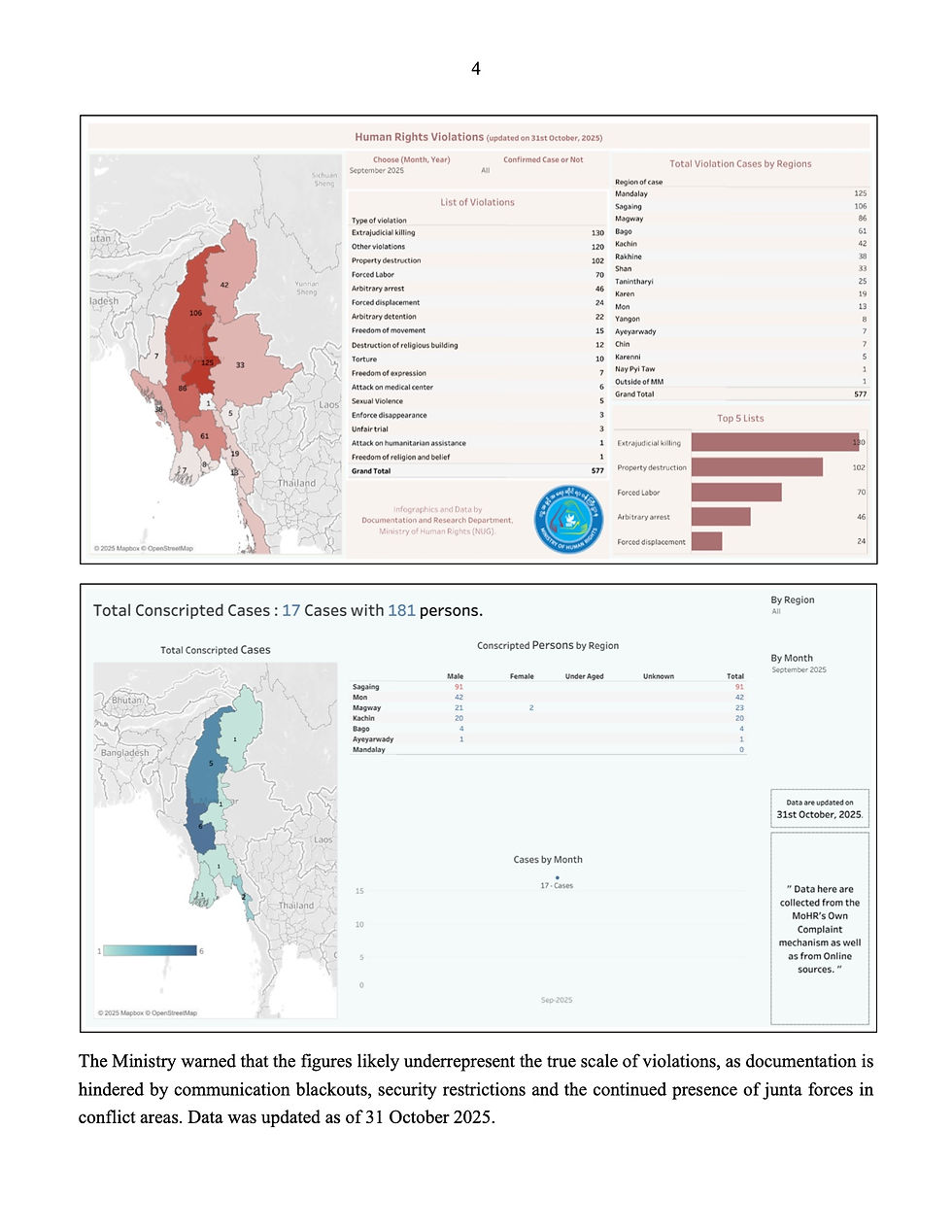
Overall, the Ministry recorded five hundred and seventy-seven human rights violations during the month. Extrajudicial killings remained the most common violation, with one hundred and thirty cases, followed by property destruction, forced labour, arbitrary arrest and forced displacement. Mandalay Region recorded the highest number of violations, followed by Sagaing, Magwe and Bago regions. The data shows that violations have reached severe levels across central Myanmar, particularly in areas experiencing ongoing resistance activity.
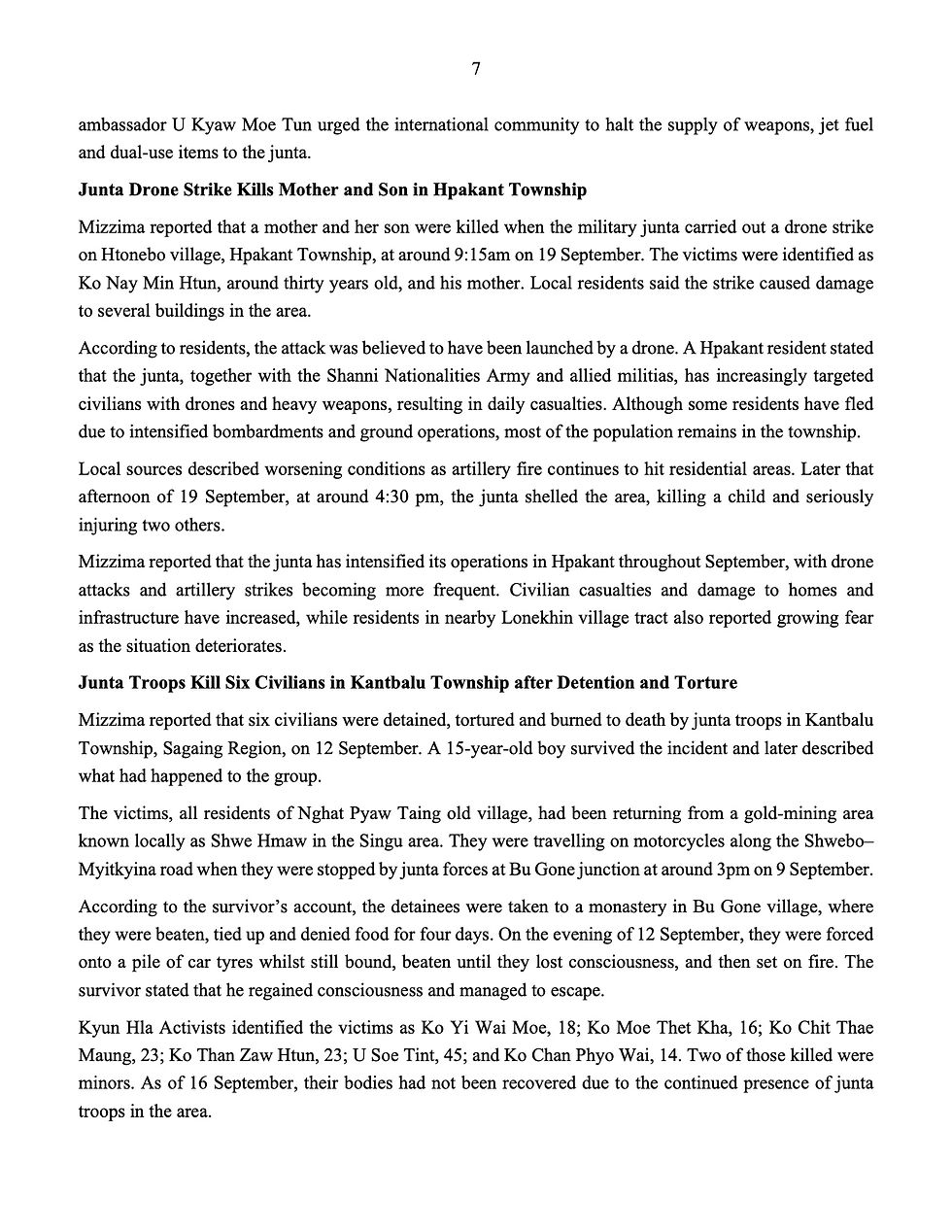
The junta also intensified forced conscription during the month. Seventeen cases involving one hundred and eighty-one conscripted individuals were documented, with Sagaing Region once again recording the highest number. Conscription affected men, women and minors, as well as individuals of unknown age.
The Ministry warned that the figures likely underrepresent the true scale of violations, as documentation is hindered by communication blackouts, security restrictions and the continued presence of junta forces in conflict areas. Data was updated as of 31 October 2025.
Human rights groups note that the pattern of widespread, deliberate attacks on civilians, civilian infrastructure and protected objects, along with extrajudicial killings and forced conscription, constitutes clear violations of international humanitarian law and may amount to war crimes and crimes against humanity.
Junta Intensifies Airstrikes Following so-called Election Announcement
The Irrawaddy reported that the military junta has sharply escalated its aerial attacks since announcing a so-called election date on 18 August, almost doubling the number of airstrikes and killing more than one hundred civilians within a month. Both air and ground offensives aimed at regaining lost territory and tightening control have intensified across resistance-held and contested areas.
According to data compiled by The Irrawaddy, the junta carried out twenty-seven airstrikes on twenty townships during the month following the announcement, compared with nineteen airstrikes on ten townships in the previous month. Despite the increase in attacks, civilian casualties remained severe, with at least one hundred deaths and one hundred and twenty-two injuries recorded. Among the dead were twenty-seven children, twelve women and three monks. The previous month saw one hundred and eighteen fatalities and ninety-two injuries.
More recent airstrikes on 21 and 22 September in Thabeikkyin and Singu townships of Mandalay Region, Kantbalu Township of Sagaing Region and Hsawlaw Township of Kachin State resulted in eight deaths and twenty-nine injuries. The Irrawaddy reported that four incidents amounted to massacres of more than ten people, occurring in Kyauktaw and Mrauk-U in Rakhine State, Kyaukme in Shan State and Shwegu in Kachin State, all areas under resistance control.
On 18 September, an airstrike on Shwegu Township killed seventeen people and injured nineteen. Kachin media stated that the strike hit an area where the Kachin Independence Army had been preparing to open a training school. Earlier, on 12 September, an aerial attack struck two private boarding schools in Thayat Tabin Village in Kyauktaw Township, an area administered by the Arakan Army, killing twenty students aged between fifteen and twenty-one. UNICEF expressed deep concern over the incident. A resident of Kyauktaw told The Irrawaddy that the community is living with constant insecurity and trauma as a result of repeated attacks, though they remain determined to end military dictatorship.
Seven of the townships targeted during this period were under the control of the Ta’ang National Liberation Army, whilst five were held by the Karenni Nationalities Defence Force and allied groups. Religious sites were also damaged, with seven Buddhist monasteries and one Christian church struck in recent attacks. Colonel Naw Bu, spokesperson for the Kachin Independence Army, said the junta routinely targets civilians, schools, hospitals and religious buildings, despite publicly denying responsibility. He urged international organisations to pay close attention to the situation, describing the attacks as war crimes.
Junta Airstrike Kills Eight Civilians, including Two Children, in Sadung Township
Myanmar Now reported that eight civilians, including two children, were killed when the military junta carried out an airstrike on Sadung Township, Kachin State, on 22 September. Six others were injured, and local residents warned that the death toll is likely to rise as more bodies are recovered from the debris.
According to the Kachin Independence Army, fighter jets from Myitkyina Airbase attacked a marketplace and an area near a school at around 2:30 pm, causing extensive damage to homes and public buildings. The strike occurred as schoolchildren were finishing classes, resulting in young students being among the casualties. Images circulating online show the bodies of two children, a dismembered victim, and destroyed houses.
Sadung, near the China–Myanmar border, came under the control of the Kachin Independence Army and its allies last year during a major anti-junta offensive. Colonel Naw Bu of the Kachin Independence Army stated that the junta has been conducting indiscriminate attacks on civilian areas, calling the airstrikes clear war crimes. The junta also launched airstrikes in Tsawlaw Township on earlier week on September, though casualties have not been confirmed.
Despite lacking control over large areas of the state, the junta has announced plans to hold elections in Mansi, Momauk and Sadung. Meanwhile, it has intensified aerial attacks nationwide, particularly in operations targeting the Arakan Army and resistance forces in central Myanmar, where civilians continue to bear the brunt of the violence.
Junta Airstrikes Kill Over 34 Civilians in Four-Day Nationwide Escalation
The Irrawaddy reported that at least thirty-four civilians, including children and women, were killed between 26 and 29 September as the military junta carried out a surge of sixteen airstrikes across Sagaing, Magwe, Bago and Mandalay regions and Kachin, Chin, Karen, Rakhine and Shan states. Two resistance bases were also hit, killing seventeen fighters.
On 29 September, two fighter jets bombed the market in Sadon town, Waingmaw Township, an area administered by the Kachin Independence Army, killing eight civilians including two children, according to Colonel Naw Bu. Around the same time, a jet dropped three 500-pound bombs on Paletwa Town in Chin State, controlled by the Arakan Army, killing two women and injuring nineteen others, with a public hospital among the destroyed infrastructures.
The Arakan Army stated that the junta has intensified attacks on schools, markets, hospitals and populated areas in retaliation for battlefield losses. In Sagaing Region, junta gyrocopters bombed villages in Taze and Ye-U townships, days after an earlier strike in Kaduma Village killed eleven civilians, according to the Ministry of Human Rights of the National Unity Government.
According to the National Unity Government, the junta conducted 3,402 airstrikes between January 2023 and August 2025, killing 3,689 people. At the UN General Assembly on 27 September, Myanmar’s ambassador U Kyaw Moe Tun urged the international community to halt the supply of weapons, jet fuel and dual-use items to the junta.
Junta Drone Strike Kills Mother and Son in Hpakant Township
Mizzima reported that a mother and her son were killed when the military junta carried out a drone strike on Htonebo village, Hpakant Township, at around 9:15am on 19 September. The victims were identified as Ko Nay Min Htun, around thirty years old, and his mother. Local residents said the strike caused damage to several buildings in the area.
According to residents, the attack was believed to have been launched by a drone. A Hpakant resident stated that the junta, together with the Shanni Nationalities Army and allied militias, has increasingly targeted civilians with drones and heavy weapons, resulting in daily casualties. Although some residents have fled due to intensified bombardments and ground operations, most of the population remains in the township.
Local sources described worsening conditions as artillery fire continues to hit residential areas. Later that afternoon of 19 September, at around 4:30 pm, the junta shelled the area, killing a child and seriously injuring two others.
Mizzima reported that the junta has intensified its operations in Hpakant throughout September, with drone attacks and artillery strikes becoming more frequent. Civilian casualties and damage to homes and infrastructure have increased, while residents in nearby Lonekhin village tract also reported growing fear as the situation deteriorates.
Junta Troops Kill Six Civilians in Kantbalu Township after Detention and Torture
Mizzima reported that six civilians were detained, tortured and burned to death by junta troops in Kantbalu Township, Sagaing Region, on 12 September. A 15-year-old boy survived the incident and later described what had happened to the group.
The victims, all residents of Nghat Pyaw Taing old village, had been returning from a gold-mining area known locally as Shwe Hmaw in the Singu area. They were travelling on motorcycles along the Shwebo–Myitkyina road when they were stopped by junta forces at Bu Gone junction at around 3pm on 9 September.
According to the survivor’s account, the detainees were taken to a monastery in Bu Gone village, where they were beaten, tied up and denied food for four days. On the evening of 12 September, they were forced onto a pile of car tyres whilst still bound, beaten until they lost consciousness, and then set on fire. The survivor stated that he regained consciousness and managed to escape.
Kyun Hla Activists identified the victims as Ko Yi Wai Moe, 18; Ko Moe Thet Kha, 16; Ko Chit Thae Maung, 23; Ko Than Zaw Htun, 23; U Soe Tint, 45; and Ko Chan Phyo Wai, 14. Two of those killed were minors. As of 16 September, their bodies had not been recovered due to the continued presence of junta troops in the area.
Local groups reported that since August the junta has intensified efforts to tighten control along the strategic Shwebo–Myitkyina route, establishing checkpoints and troop positions in areas including Zee Kone–Ma Lae, Bu Gone and Yay Kyi Oo. Resistance and civil society organisations have warned that civilians continue to face arrest, torture and killings in these locations, advising travellers to avoid the route or exercise extreme caution.
Human Rights Abuses
Junta Files Charges Against KNU and Chinland Leaders Under Election Law
Mizzima reported that the junta’s Ministry of Home Affairs has charged at least forty individuals, including senior leaders of the Karen National Union and members of the Chinland government, under the junta’s so-called Election Protection Law. The so-called law has been increasingly used to target critics of the sham election.
According to the announcement, eleven senior figures from the Karen National Union have been charged, including Chairman Pado Saw Kwe Htoo Win, Vice-Chairman Pado Saw Say Gay, General Secretary Pado Ta Doh Moo, Joint Secretaries Pado Saw Thaw Thi Bwe and Pado Saw Hla Tun, and Central Committee members General Saw Johnny, Major General Saw Tamla Thaw, Pado Saw Law Eh Moo, Pado Saw Eh Kalu Say, Pado Naw Dar Dar and Pado Saw Taw Nee. The cases were filed at Hlaingbwe Township Police Station in Karen State on 29 August and 1 September, accusing the leaders of making statements on 12 and 30 August that allegedly disrupted the election process. The Karen National Union has publicly rejected the junta’s planned sham election.
Mizzima reported that seventeen others have also been charged since late August, including Chinland government Prime Minister Pu Pa Thang, as well as members of the Arakan Army and the People’s Defence Force. The announcement further stated that five residents of Loikaw Township in Karenni State, including three minors, and four residents of Shwepyitha Township in Yangon have been arrested, with additional investigations ongoing.
Junta Arrests Two Men in Yangon for Anti-Election Posters
The Irrawaddy reported that the military junta arrested two men in Hlaing Tharyar Township, Yangon, for putting up anti-election posters in public areas. According to the junta’s Ministry of Information, the two victims, identified as Aung Ye Htut, 24, and Yan Naing Kyi Win, 23, were detained on 20 September after junta forces raided a house in No. 6 Ward following a tip-off that anti-election stickers had been placed on a street signboard in Shwe Lin Ban village.
The junta stated that the two men admitted to placing similar stickers in multiple locations across the township with the intention of opposing the planned sham election. Both have been charged under Section 23(a) of the Election Protection Law, enacted on 29 July, which carries severe penalties ranging from three years’ imprisonment to the death penalty depending on the nature of the alleged offence.
The Irrawaddy reported that earlier in September, a blogger from Taunggyi, Ko Nay Thway, became the first person sentenced under the law, receiving seven years in prison for comments deemed to mock the junta’s ability to conduct elections. On 5 September, the junta’s Deputy Minister for Home Affairs instructed authorities to take action against social media users opposing the sham election.
The first phase of the junta’s proposed so-called election is scheduled for 28 September in 102 townships. The junta’s electoral body has acknowledged that voting cannot take place in fifty-six townships due to current conditions. Opposition groups, international human rights organizations and election observers have denounced the sham election as an attempt to prolong military rule.
Actions of Resistance Forces against the Junta
PDF Seizes Banmauk Town in Northern Sagaing after Five-Day Offensive
The People’s Defense Force seized Banmauk Town in northern Sagaing Region on 21 September, following a five-day offensive against junta troops and the allied Shanni National Army, according to a statement issued by the National Unity Government’s No. 1 Military Region Command.
Banmauk, which borders Indaw and Katha townships near Kachin State, is considered a strategic location for resistance operations in northern Sagaing. A source close to the PDF told The Irrawaddy that the town is now under full resistance control, with no junta troops remaining. According to the National Unity Government, PDF fighters engaged a combined force of around four hundred junta, police, militia and Shanni National Army personnel, capturing eighteen positions including three monasteries and a school. The junta reportedly launched around a dozen airstrikes, supported by drones and artillery.
Junta and Shanni National Army forces have reportedly withdrawn to Mangon and Ahnauktaw villages, located fourteen kilometres northwest of Banmauk. A military analyst told The Irrawaddy that the fall of Banmauk enables resistance forces to consolidate control over a wider mountainous and forested area already dominated by anti-junta groups. The capture places resistance fighters closer to junta-held towns including Homalin, Wuntho and Paungbyin.
Activities of the National Unity Government
NUG and KNU Leaders Hold Talks to Strengthen Revolutionary Cooperation
Mizzima reported that Duwa Lashi La, Acting President of the National Unity Government, held discussions with Karen National Union Chairman Padoh Kwe Htoo Win on 25 September to enhance cooperation among resistance forces. The meeting was announced in a joint statement released by the National Unity Government and KNU-Central.
According to the statement, the two leaders conducted an in-depth discussion on areas where revolutionary organizations can strengthen coordination to accelerate the success of the Spring Revolution. Both pledged to work more closely with other resistance groups to achieve the full liberation of Myanmar from military dictatorship and to end tyranny. The statement added that the leaders reaffirmed their commitment to continued cooperation in pursuit of freedom, peace and prosperity for the people of Myanmar.
NUG, NUCC and CRPH Declare SSPC Illegitimate and Announce Legal Action
Mizzima reported that the National Unity Government, the National Unity Consultative Council and the Committee Representing Pyidaungsu Hluttaw issued a joint statement on 18 September declaring the junta’s newly formed State Security and Peace Commission and its affiliated bodies illegitimate.
According to the statement, the National Unity Government will take action against the rebranded junta structure under the Anti-Terrorism Law. U Nay Phone Latt, spokesperson for the National Unity Government Prime Minister’s Office, told Mizzima that the Central Committee for Counter-Terrorism has previously designated groups involved in forced conscription and the junta’s Election Commission as terrorist organizations. He added that further statements and legal action will follow, including efforts to arrest members of the military in accordance with the law.
The joint statement further noted that because the State Security and Peace Commission was formed out of the State Administration Council, it should be regarded as an enemy of Myanmar and its people. It also affirmed that the junta’s designation of ethnic armed organizations and revolutionary groups as terrorist organisations is illegitimate and void.
Myanmar PR warns that support for junta’s “scam election” will push its nuclear ambitions closer
Ambassador Kyaw Moe Tun told the High-Level Plenary Meeting on 26 September 2025 that widening geopolitical tensions, a deteriorating security environment and unprecedented conflicts are undermining nuclear disarmament efforts. He reaffirmed that “the only guarantee against the use of nuclear weapons is their total elimination,” stressing the catastrophic consequences of any use.
Ambassador said the NPT remains the cornerstone of disarmament and non-proliferation, and called the failure of recent Review Conferences disappointing. He noted that the TPNW “complements the NPT” and welcomed preparations for the Third Meeting of States Parties. He urged all remaining Annex II States to ratify the CTBT without delay.
The Ambassador recalled that under the elected civilian government, Myanmar acceded to the CTBT and signed the TPNW, but said these efforts were “disrupted by the attempted illegal military coup.” He warned that while escalating indiscriminate airstrikes, shelling and artillery attacks against civilians, the military is also “desperately reaching for their long-standing nuclear ambitions” and deepening cooperation with a nuclear-weapon State under the guise of peaceful use.
He stated that the military plunges the country into chaos and committing heinous crimes to their own civilians. He stressed that any international support or assistance to the military junta’s scam election will render its dangerous nuclear ambitions a step closer.
He concluded by urging all Member States to cut the flow of arms, weapons, jet fuel and dual-use items to the junta to save lives and protect Myanmar’s future.
Myanmar’s Permanent Representative warns junta’s attacks undermine Rohingya repatriation and urges rejection of “scam election”
Myanmar’s Permanent Representative to the United Nations, Ambassador Kyaw Moe Tun, told the High-level Conference on the Situation of Rohingya Muslims and Other Minorities in Myanmar on 30 September 2025 that the situation of the Rohingya remains a long-standing and severe humanitarian and human rights crisis. He stated continued aerial attacks by the junta across Myanmar, including in Rakhine State, mean there is no near-term prospect for safe, secure, dignified and voluntary repatriation.
The Ambassador noted that the National Unity Government adopted a Policy Position on the Rohingya in 2021 and is committed to resolving the issue as part of its core objectives. He said creating a conducive environment for return requires ending the military dictatorship, stopping its atrocities, and strengthening trust and unity.
Ambassador Kyaw Moe Tun urged the international community not to support the junta politically, militarily or financially and to strongly reject the junta’s planned “scam election,” stressing that the suffering of the people of Myanmar, including the Rohingya, is well understood. He stated the crisis cannot be resolved without addressing the root cause: the junta’s unlawful coup and its entrenched impunity, and called for decisive action to ensure the international community does not fail the people of Myanmar.
Response of the International Community
UNHRC reports escalating human rights crisis for Rohingya amid renewed conflict in Rakhine State
The United Nations High Commissioner for Human Rights released an update on 26, September 2025 detailing the deteriorating situation of Rohingya Muslims and other minorities in Myanmar. According to the UN Human Rights Office, nearly all civilians in Rakhine, including ethnic Rakhine communities, have been severely affected by intensified conflict, particularly due to the military’s repeated use of aerial bombardment against residential areas and its denial of humanitarian access.
OHCHR said that since November 2023 more than a quarter of the Rohingya population remaining in Myanmar after the 2017 crisis have fled the country seeking safety. The Office has monitored human rights conditions in Rakhine State for many years, especially following the 2012 and 2016–2017 crises and after the 2021 coup, producing 15 reports and 19 oral updates to the General Assembly and the Human Rights Council.
The update supplements OHCHR’s report presented to the 60th session of the Human Rights Council, covering April 2024 to May 2025, and focuses on current conflict dynamics and their impact on civilians ahead of the High-level Conference on the Rohingya in New York on 30 September. Over the past year, OHCHR held 20 consultations with Rakhine communities, including the Rohingya, discussing human rights protection, accountability, governance and aspirations for a democratic civilian-led government. Findings also draw on consultations with Rohingya refugees in Cox’s Bazar and 28 interviews conducted between June and August 2025, in addition to monitoring activities, field visits and analysis of credible UN sources.
ANFREL warns planned December elections lack democratic legitimacy
The Asian Network for Free Elections (ANFREL) reported on 30 September that the military-controlled authorities are preparing to hold elections on 28 December 2025 that fall far below international democratic standards. In its assessment, Myanmar Junta’s Planned Elections: Falling Short of Democratic Legitimacy, the organisation identified 15 areas where the process violates basic principles, noting that the vote is unfolding amid widespread violence, restrictive laws, and the exclusion of independent oversight.
ANFREL stated that only parties approved by the military-controlled administration will be permitted to compete, while independent media and civil society monitors are barred. The report highlighted the introduction of untested electronic voting machines, continued curbs on freedoms of assembly and expression, and an electoral framework designed to maintain military control rather than enable a genuine democratic transition.
According to ANFREL, the polls will not resolve the political crisis and are widely viewed as “sham elections” that risk deepening divisions and prolonging suffering. The organisation warned that any international recognition of the process could provide legitimacy to continued military rule and undermine regional commitments to democratic norms.
ANFREL said its findings were based on extensive monitoring, stakeholder interviews, and nearly two decades of experience observing elections in Myanmar, including the 2015 and 2020 polls. It pledged to continue working with Myanmar civil society and regional partners to highlight the risks associated with the planned vote and to uphold democratic principles.
New Zealand MPs call for rejection of the junta’s sham elections and increased humanitarian support
New Zealand opposition MPs Phil Twyford, Rachael Boyack, and Teanau Tuiono urged Wellington and the wider international community to reject the junta’s planned December 2025 sham elections, warning that the process is intended to entrench military control rather than advance a democratic transition. Their remarks were made at the Foreign Correspondents’ Club of Thailand in Bangkok following a nine-day fact-finding mission to the Thai–Myanmar border.
Boyack, from the Labour Party, said Myanmar’s crisis had been overshadowed by other global conflicts and called for a significant increase in humanitarian assistance that effectively reaches communities inside Myanmar. She noted Thailand’s pragmatic facilitation of aid efforts but warned of deteriorating conditions along the Indian and Chinese borders.
Tuiono, of the Green Party, said every group they met from exiled politicians to youth activists — had appealed for the international community to reject the junta’s sham elections. He observed that with the military controlling only a fraction of the country, no credible or fair process could take place. He stated that the international community must reject the polls.
Twyford described Myanmar as the worst conflict in Asia and a major source of forced displacement. He criticized wavering liberal democracies for considering engagement with the military-controlled authorities and urged governments to remain principled in their approach. He also expressed concern over ASEAN’s muted response and said China’s support made it complicit in ongoing violations.
The delegation reported increasing support for federal democracy and community-led governance initiatives, including health and education services established by ethnic groups. They also highlighted concerns over declining international aid, noting reductions in United States support and worsening food insecurity for Rohingya refugees in Bangladesh. While welcoming discussions on an ASEAN humanitarian fund, they stressed that any assistance must bypass military-controlled channels to reach affected populations.
The MPs pledged to press New Zealand’s government to reject the sham elections, reassess humanitarian assistance, and strengthen engagement with Myanmar’s democracy movement, stressing that the people of Myanmar deserve a future grounded in freedom and self-determination.
IIMM documents systematic destruction and seizure of Rohingya property during 2017 genocide
The Independent Investigative Mechanism for Myanmar (IIMM) released a report on 29 September 2025 detailing the destruction and dispossession of Rohingya land and property during the 2017 clearance operations in northern Rakhine State. The report outlines how homes, farms, mosques and entire villages were destroyed after Rohingya communities fled, and how junta forces and associated entities subsequently seized and repurposed the land, including through the construction of Border Guard Police (BGP) bases.
According to the IIMM, evidence collected from witnesses, geospatial imagery, video footage and official documents shows that in all seven village tracts examined, the Myanmar military destroyed Rohingya settlements and constructed BGP bases on the cleared land. In Myo Thu Gyi, for example, more than 800 structures existed prior to 2017, yet by 2018 over 411 acres had been burned and flattened and a large BGP base had been built in their place.
The report identifies beneficiaries of the widespread dispossession, including the Ministry of Home Affairs, which financed and directed the expansion of BGP facilities; the BGP, which occupied confiscated land; and corporations such as Asia World Company involved in constructing bases, roads and security outposts. The Mechanism stated that these actions were part of a broader effort to erase the Rohingya community’s longstanding presence in the region.
IIMM Head Nicholas Koumjian said the findings underscore the challenges facing any future safe, voluntary, dignified and sustainable repatriation, noting that many Rohingya villages “no longer exist”. He emphasized that restitution and assistance will be essential for communities to rebuild.
The public summary released on 29 September precedes the High-Level Conference on the Situation of Rohingya Muslims and Other Minorities in Myanmar, held at the United Nations on 30 September. The Mechanism said it is prepared to share its full confidential report, which includes identifying information and detailed evidence, with competent national and international authorities to support investigations or reparations for crimes committed in Myanmar.
US sanctions Myanmar-linked arms trafficking network supplying junta with North Korean weapons technology
The United States Department of the Treasury announced that new sanctions targeting five individuals and one entity involved in illicit arms trafficking networks supporting North Korea’s WMD and ballistic missile programmes, including through the supply of weapons technology to the military junta in Myanmar. OFAC said the measures expose and disrupt a procurement network that facilitated sales from the Korea Mining Development Trading Corporation (KOMID) to the junta.
According to OFAC, the centre of the network is Royal Shune Lei Company Limited, a Myanmar-based procurement firm that brokered its first deal with KOMID in 2022 and arranged the transfer of aerial bomb guidance kits, bombs and airborne monitoring equipment to the Myanmar Air Force. Treasury reported that Royal Shune Lei executives, including CEO Tin Myo Aung and employee Kyaw Thu Myo Myint, travelled to China to coordinate directly with North Korean officials, and that KOMID provided weapons samples for testing prior to finalizing the junta’s orders.
The sanctions highlight the role of foreign intermediaries in sustaining the junta since the February 2021 coup, during which it has intensified airstrikes that have repeatedly struck civilian infrastructure, including schools, hospitals and religious sites. Washington said the designations cut off an important funding stream for Pyongyang while targeting the junta’s ability to acquire advanced aerial munitions.
All U.S. assets linked to the designated individuals and entity are now blocked, and U.S. persons are prohibited from conducting transactions with them. Treasury further warned international financial institutions that dealings with the sanctioned network could expose them to secondary sanctions.
*****
Date: 30 September 2025
Permanent Mission of Myanmar, New York