Bi-weekly Update on the Current Situation in Myanmar (16-03-2026 to 31-03-2026)


Bi-weekly Update on the Current Situation in Myanmar
(16-03-2026 to 31-03-2026)
(62) months ago, on 1 February 2021, the military junta attempted an illegal coup, toppled the elected civilian government, and unlawfully detained State Counsellor Daw Aung San Suu Kyi, President U Win Myint, and other senior members of the civilian government, parliamentarians and activists. Since then, the military junta has ignored the will of the people of Myanmar, placed the country in turmoil, and made people suffer tremendously as a result of its inhumane and disproportionate acts.
Over 3.6 million people are being displaced. Almost 22 million people are in need of humanitarian assistance. Among them, over 10.4 million are women and girls, and over 6.3 million are children. 116,897 houses were burned down throughout Myanmar since the illegal coup until the end of 31 May 2025, according to Data for Myanmar.
According to the UNDP, 49.7 per cent of the population in Myanmar was living under the national poverty line in 2023. Its report in June 2025 further revealed that even in Myanmar's commercial hub, Yangon, nearly half of the city's population lives in poverty, and the economic collapse, displacement, and inadequate services are pushing more families into poverty every day. Moreover, due to the complete dismantling of the rule of law by the junta, transnational organised crimes including online scams, drug trafficking, and human trafficking are rising across the country and generating serious security implications for the region and beyond.
The suffering of the people has been further compounded by the 7.7 magnitude earthquake which struck Myanmar on 28 March 2025. Sagaing Region, Mandalay Region, and Nay Pyi Taw were among the hardest hit. The earthquake killed almost 4,200 people, injured over 3,680 others, and affected over 3.2 million people. Infrastructure, houses, and religious facilities were severely destroyed.
According to the Assistance Association for Political Prisoners (AAPP), in March 2026, 115 pro-democracy activists and civilians lost their lives, among whom 33 died under various circumstances following their arrest. These are the numbers verified by the AAPP, which noted that it was working separately to collect and verify information on approximately 250 additional people who died within the month and whose identities had yet to be confirmed. The actual numbers on the ground are likely much higher. Amidst such suffering, the military junta has continued carrying out atrocities, aerial and artillery attacks across the country.
War Crimes, Crimes against Humanity and Mass Murders Committed by the Military Junta
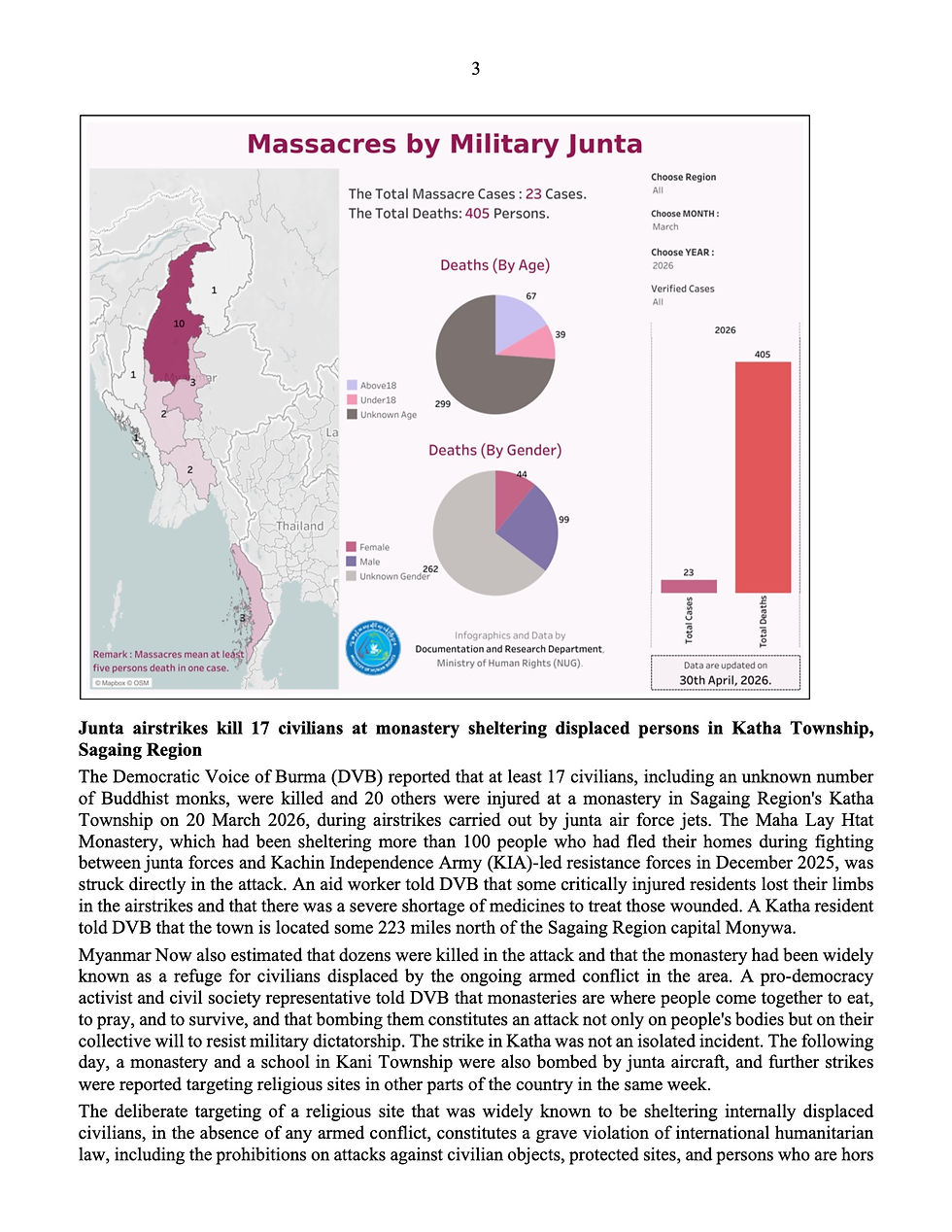
NUG Ministry of Human Rights Documents 520 Violations and 23 Massacres Across Myanmar in March 2026
The Documentation and Research Department of the National Unity Government's Ministry of Human Rights recorded 520 human rights violations committed by the military junta across Myanmar in March 2026.
Property destruction recorded the highest number of violations, totalling 133 cases, followed by extrajudicial killings at 117 cases and other violations at 105 cases. Forced labour accounted for 78 cases, while arbitrary arrests stood at 23 cases and forced displacement at 19 cases. The data also documented 12 cases of destruction of religious buildings, eight cases each of restrictions on freedom of movement and torture, seven cases of arbitrary detention, four attacks on medical centres, three cases of enforced disappearance, and one case each of child soldier recruitment, restriction of freedom of religion and belief, and unfair trial.
Mandalay Region recorded the highest number of violations with 95 cases, followed by Sagaing Region with 74 cases and Magway Region with 72 cases. Tanintharyi Region and Rakhine State each recorded 47 cases, while Bago Region also recorded 47 cases. Chin State recorded 34 cases, Kayin State 22 cases, Ayeyarwady Region 18 cases, Shan State 16 cases, Yangon Region 15 cases, Kachin State 14 cases, Kayah State 10 cases, and Mon State 7 cases.
In a separate dataset covering the same period, the Ministry of Human Rights documented 23 massacre cases committed by the military junta resulting in the deaths of 405 persons. Under the methodology applied, a massacre is defined as an incident in which at least five persons are killed in a single case. Sagaing Region recorded the highest number of massacre cases with 10, followed by Mandalay Region and Tanintharyi Region with 3 cases each, Magway Region and Rakhine State with 2 cases each, and Bago Region and Chin State with 1 case each.
Of the 405 deaths recorded, 39 were children under the age of 18, 67 were adults above the age of 18, and the ages of 299 victims remain unconfirmed. By gender, 44 of the deceased were female and 99 were male, while the gender of 262 victims has yet to be confirmed.
Junta airstrikes kill 17 civilians at monastery sheltering displaced persons in Katha Township, Sagaing Region
The Democratic Voice of Burma (DVB) reported that at least 17 civilians, including an unknown number of Buddhist monks, were killed and 20 others were injured at a monastery in Sagaing Region's Katha Township on 20 March 2026, during airstrikes carried out by junta air force jets. The Maha Lay Htat Monastery, which had been sheltering more than 100 people who had fled their homes during fighting between junta forces and Kachin Independence Army (KIA)-led resistance forces in December 2025, was struck directly in the attack. An aid worker told DVB that some critically injured residents lost their limbs in the airstrikes and that there was a severe shortage of medicines to treat those wounded. A Katha resident told DVB that the town is located some 223 miles north of the Sagaing Region capital Monywa.
Myanmar Now also estimated that dozens were killed in the attack and that the monastery had been widely known as a refuge for civilians displaced by the ongoing armed conflict in the area. A pro-democracy activist and civil society representative told DVB that monasteries are where people come together to eat, to pray, and to survive, and that bombing them constitutes an attack not only on people's bodies but on their collective will to resist military dictatorship. The strike in Katha was not an isolated incident. The following day, a monastery and a school in Kani Township were also bombed by junta aircraft, and further strikes were reported targeting religious sites in other parts of the country in the same week.
The deliberate targeting of a religious site that was widely known to be sheltering internally displaced civilians, in the absence of any armed conflict, constitutes a grave violation of international humanitarian law, including the prohibitions on attacks against civilian objects, protected sites, and persons who are hors de combat. The Interim Executive Council and local civil society organisations called on the international community to impose concrete measures to stop the junta's aerial campaign against the civilian population.
Junta airstrikes kill at least 27 civilians across Sagaing Region since 20 March 2026
DVB reported that at least 27 civilians were killed in a sustained wave of airstrikes carried out by the junta air force across Sagaing Region's Myaung, Ayardaw, Kani, and Katha townships in the days following 20 March 2026. The four towns are located between 25 and 223 miles northeast, north, and southeast of the Sagaing Region capital Monywa. The attacks extended a pattern of intensifying aerial bombardment across Sagaing Region, which has remained one of the areas most severely affected by junta aerial violence since the illegal coup.
Four civilians in Myaung Township were killed on 23 March when a junta air force jet dropped four bombs on civilian areas. A People's Defence Force member in Myaung told DVB that the number of casualties was likely to rise further, as many civilians were trapped under the rubble of destroyed buildings and at least 40 homes had been burned down as a result of the strikes. At least six residents were killed by two junta jets in Ayardaw Township on 22 March. Residents of Kani Township reported that at least four civilians were injured when airstrikes struck a Buddhist monastery and a school on 21 March, the day after the devastating Katha monastery strike.
The sustained aerial campaign across multiple townships reflects the junta's systematic and indiscriminate targeting of civilian areas in Sagaing Region. Civil society groups warned that the pattern of airstrikes targeting monasteries, schools, and civilian settlements, in the absence of any military necessity, constitutes a deliberate campaign of collective punishment designed to terrorise the civilian population into submission, in gross violation of international humanitarian law.
Junta troops at Defence Industry factory shell villages in Aunglan Township, Magway Region, sparking fires and mass displacement
Mizzima reported that on 17 March 2026, a junta military unit based within the Defence Industry 15 factory, known locally as KaPaSa 15, launched a heavy artillery assault on civilian areas in south-western Aunglan Township, Magway Region. Howitzer shells reportedly struck Intawthar village, causing multiple explosions that ignited a large fire in the northern section of the settlement. A local source told Mizzima that junta forces were targeting a village called Ywarmahtone, located near the gate of the weapons factory, and that the northern section of Intawthar village had already been burned with the fire spreading toward the south and no one left to control the flames.
The source also noted that artillery shelling had struck Intawthar Village on 16 March as well, and that while no human casualties were reported from that earlier attack, livestock were killed in the bombardment. Mizzima reported that junta forces had been continuously shelling villages in south-western Aunglan Township since early March, sometimes accompanied by drone surveillance and strikes. Earlier in the month, approximately 3,000 residents from seven villages in the same sub-township had already been forced to flee following a separate three-day artillery and drone bombardment carried out between 1 and 3 March, which had destroyed 27 houses and a monastery dining hall in Dazan Village alone.
Locals said that the use of surveillance drones alongside the artillery campaign may signal an impending ground offensive by junta forces, and urged remaining residents to stay vigilant as junta forces continued to reposition heavy weaponry in the area. The sustained targeting of civilian villages in Aunglan Township by a junta unit operating from a military weapons manufacturing facility reflects the systematic use of state-produced munitions against the civilian population in Magway Region, in violation of international humanitarian law's prohibition on indiscriminate attacks.
Junta paramotor attack kills four villagers in Mahlaing Township, Mandalay Region
Mizzima reported that four villagers were killed and a young child was seriously injured during a targeted paramotor attack by junta forces on Nyaung Kone Village in Mahlaing Township, Mandalay Region, on 26 March 2026. According to the Mahlaing Public Information Network, the attack occurred at 2:45 pm when two junta paramotors dropped four bombs on the residential area. The victims included one woman and three men, while the injured child was transported for emergency medical treatment. The strike caused significant destruction to civilian property, with at least eight houses damaged and electricity poles destroyed, leading to widespread power outages in the surrounding area.
Local officials of the Mahlaing Public Information Network emphasised to Mizzima that there were no active clashes or presence of resistance forces in Mahlaing Township at the time of the attack, and described the incident as a deliberate assault on a peaceful civilian area. The network stated that although Mahlaing Township is an area nominally under junta forces' control and no People's Defence Force members were present in the vicinity, the attack was carried out without any military justification. Junta forces had conducted at least five previous airstrikes on villages in Mahlaing Township, establishing a pattern of aerial attacks on civilian settlements in the area.
The Mahlaing Public Information Network urged the public to disperse immediately and avoid gathering in groups upon hearing aircraft, and advised residents to dig bomb shelters in preparation for further potential attacks. A local official told Mizzima that since it was the first time local people had experienced such an event, they were in a state of shock and fear. Rights groups condemned the attack as part of the junta's expanding use of dual use items like paramotor aircraft to conduct low-altitude strikes on civilian areas across the country, a practice that has escalated sharply since late 2024.
Junta aerial campaign continues to devastate Myingyan District, Mandalay Region
Mizzima reported that the sustained and brutal aerial campaign by the military junta launched since January 2026 continued to devastate Myingyan and Natogyi townships in Myingyan District, Mandalay Region, with the cumulative death toll surpassing 100 and the number of homes destroyed exceeding 4,000. The Myingyan Township Humanitarian Committee, which compiled the data in cooperation with Mizzima, warned that the actual death toll was likely even higher than the figures so far confirmed. The junta's aerial attacks have systematically targeted religious and public buildings, including monasteries, pagodas, and schools. The Humanitarian Committee stated that more than 200 houses were destroyed directly by airstrikes alone.
A local resident told Mizzima that fires were occurring nearly every day and that tens of thousands of displaced people were suffering, with nowhere to return to because their homes were being burned until nothing remained. Among those killed were children, approximately five monks and novices, and residents who died of heart attacks caused by the proximity of bombings, despite not being struck directly. Dozens of villages across the two townships have been burned or heavily damaged, including Chaysay, Kwansaik, Kansink (North), Letwe, Myingni, Sinkut, Tasoe, Male, Nyaungto, Kanhnaung, Ywagyi, Ywathit, Khansatgone, Lonedaw, Thamantaw, Kwinpyangone, Thanpo, Yonesingyi, Yonesinlay, Seto, Shwemadaw, Kwanohn, Incahung, Mangyisu, Hteinpanthitywa, Thamonekaing, Phone, Sanpya, Thaedaw, Layywasone, Letthamarkan, Pyathatgyi, Tazaung, Nabuaing, Pyitawtha, Thabyaythar, Taungshae, and Aungpyisoe.
According to the Myingyan Township Humanitarian Committee, several villages including Ywathitgyi, Magyisu, Kanswe, Letwe, Myingni, Tasoe, Male, Talokemyo, Thinbawtin, Darguun, Nyaungpin, Pyar, and Khansatgone have been almost completely burned to ashes. The scale of destruction and the sustained, indiscriminate nature of the junta's aerial campaign in Myingyan District constitute grave violations of international humanitarian law, including the prohibition on attacks against civilian objects and protected sites such as monasteries and pagodas.
Human Rights Abuses
Political prisoner Ma Thet Thet Mar dies in Taze Detention Centre after denial of medical care
Mizzima reported that Ma Thet Thet Mar, a 54-year-old political prisoner, died in her cell at the Taze Detention Centre in Sagaing Region on the morning of 27 March 2026, after reportedly being denied essential medical care. Her death adds to a growing and deeply concerning record of deaths in junta detention facilities that rights groups have consistently attributed to the deliberate denial of healthcare to political detainees. The Assistance Association for Political Prisoners has documented numerous cases of political prisoners dying in custody due to inadequate or withheld medical treatment since the illegal coup of February 2021.
Ma Thet Thet Mar's death follows a broader pattern in which the junta uses detention conditions, including the deliberate denial of medicines, as a tool of repression against political prisoners. Rights groups condemned the death as a further violation of the minimum standards for the treatment of prisoners under international law, which require that all detained persons receive adequate medical care. They called on the international community to press for the immediate release of all political prisoners in Myanmar and to hold those responsible for deaths in custody accountable.
Systemic torture, medical neglect and forced labour documented at Daik-U Prison, Bago Region
Mizzima reported that sources close to the notorious Daik-U Prison in Bago Region, including the Political Prisoners Network Myanmar, described a sharply deteriorating human rights situation in which political prisoners were subjected to systemic torture, medical neglect, and dehumanising forced labour. Those unable to pay bribes to prison staff were reportedly singled out for the most severe forms of mistreatment. A person close to the prison told Mizzima that political prisoners were being moved between wards, forced to carry sewage water, and subjected to excessive forced labour, and that even those suffering from injuries caused by torture were not spared. The source added that those who demanded their rights were being placed in solitary confinement with shackles.
Even when medicine was sent in by family members, political prisoners reportedly did not receive the full amount due to embezzlement by prison staff. Prisoners were fed undercooked or spoiled rice under the pretext of staff shortages. Additionally, on 29 December 2025, prison staff confiscated a self-funded medical emergency fund worth approximately 3 million kyat (around US$1,428) that political prisoners had established among themselves for healthcare needs. The PPNM also released a statement confirming that the deputy jailer maintained a blacklist of prisoners who demanded sufficient medicine, and that those on the list were subjected to degrading treatment, including being forced to crawl on all fours and being beaten. Personal supplies of food and medicine were also seized from prisoners during cell searches.
Daik-U Prison has become one of the most notorious detention facilities in Myanmar since the illegal coup, with a well-documented record of torture, extrajudicial killings, and the deliberate denial of healthcare to political detainees. In July 2023, 12 political prisoners including members of the All Burma Federation of Student Unions were shot dead during a transfer from the facility. Rights groups have repeatedly called on the international community to demand accountability for conditions at Daik-U Prison and to press for the immediate release of all those held on politically motivated charges.
Yangon residents face systematic extortion linked to junta's forced conscription drive
Mizzima reported that residents of Yangon were facing systematic extortion directly connected to the junta's ongoing forced conscription campaign, with ward-level administrators and associated personnel reportedly demanding payments from civilians in exchange for exemption or deferment from military service. The extortion represents an extension of the coercive and exploitative practices that have accompanied the junta's forced conscription policy since its introduction in February 2024, which compels men aged 18 to 35 and women aged 18 to 27 to serve three to five years in junta forces. Sources in Yangon told Mizzima that the financial demands were placing severe pressure on families with limited means, who faced the choice between paying bribes or risking the forced conscription of a family member into the junta's forces.
The practice of ward administrators accepting payments to facilitate substitutions or exemptions from conscription has been reported in multiple townships across Yangon. Rights groups noted that the extortion scheme reflected a broader pattern of institutionalised corruption and coercion within the junta's conscription apparatus, in which civilian administrators at the local level are drawn into facilitating a system that violates international human rights law's prohibition on forced labour and compulsory military service.
Junta enacts new passport law sparking widespread fears of abuse and surveillance
Mizzima and The Irrawaddy reported that the military junta enacted a new passport law on 21 March 2026 aimed at tightening control over overseas travel by Myanmar citizens. The Irrawaddy reported that the new law had sparked widespread fears of abuse and surveillance among Myanmar citizens living abroad and those seeking to travel internationally, with legal experts warning that the broadly worded provisions could be used to revoke the passports of dissidents, activists, and members of resistance communities abroad. The law gives junta-controlled agencies expanded powers to cancel, suspend, or refuse to renew passports on vaguely defined grounds related to national security or conduct deemed harmful to the state.
Rights groups noted that the new passport law was consistent with a broader pattern of junta legislation designed to extend the reach of its coercive apparatus beyond Myanmar's borders, targeting the significant diaspora community and those who have sought safety abroad since the illegal coup. The law was seen as a further attempt to isolate Myanmar citizens from international protection and to weaponise documentation and bureaucratic control against perceived opponents of the junta, in violation of the internationally recognised right to freedom of movement.
New mandatory phone registration system gives junta expanded powers to track and monitor users
The Irrawaddy reported that the junta's new mandatory International Mobile Equipment Identity (IMEI) registration system, operating through its Central Equipment Identity Register, was giving junta forces significantly expanded powers to track and monitor mobile device users across Myanmar. The Myanmar Internet Project issued an urgent security warning, noting that the mandatory registration system posed grave risks to the privacy and security of users, enabling the junta to track, monitor, and identify individuals through their mobile devices in real time. Digital rights experts and human rights advocates warned that the system could be deployed to identify and target dissidents, activists, journalists, and others critical of the junta at checkpoints, airports, and city entry and exit points.
The deployment of the mandatory digital identification infrastructure followed the junta's construction of an integrated digital surveillance system that has been documented in submissions to the United Nations Special Rapporteur on peaceful assembly and association, including AI-powered CCTV systems using facial recognition, deep packet inspection internet firewalls, and spyware obtained from suppliers in China, Russia, and Iran. The mandatory IMEI registration system represents a further expansion of this surveillance apparatus, raising serious concerns under international human rights law, including the rights to privacy and freedom of expression.
Joint report documents sharp increase in junta internet censorship during sham elections
Mizzima reported that a new joint report by Human Rights Myanmar and the Independent Press Council Myanmar found that the military junta sharply increased internet censorship during the 2025 to 2026 sham election period. The report found that the junta blocked most public attempts to access independent news websites, severely restricting the flow of information about the electoral process to the public both inside Myanmar and internationally. The systematic suppression of independent media access was deployed in a coordinated manner to prevent independent scrutiny of the elections, which had been widely condemned by the NUG, ethnic resistance organisations, and the international community as a sham designed to legitimise military rule.
The findings added to a growing body of evidence documenting the junta's systematic campaign to suppress the free flow of information in Myanmar since its illegal seizure of power in February 2021. The joint report noted that the junta's censorship infrastructure constituted a violation of the internationally recognised right to freedom of expression and the right to seek, receive, and impart information, as enshrined in the International Covenant on Civil and Political Rights. Rights groups called on the international community to take concrete measures to support access to independent information for the people of Myanmar and to hold the junta accountable for its attacks on press freedom.
Actions of Resistance Forces against the Junta
Arakan Army intensifies siege of Sittwe and Kyaukphyu, targeting strategic naval bases
Mizzima reported that the Arakan Army (AA) had intensified its siege of Sittwe, the Rakhine State capital, and Kyaukphyu Township as fighting reached and targeted strategic naval bases held by the junta. The escalation of operations around Sittwe and Kyaukphyu reflected the AA's continuing efforts to complete its control over Rakhine State, following the capture of the junta's Western Regional Military Command headquarters in Ann in December 2024 and the subsequent fall of multiple townships. Junta forces based in Sittwe have continued to launch retaliatory airstrikes and naval shelling on Rakhine civilian populations in the surrounding areas in response to AA advances, adding to the severe humanitarian toll in the state.
The intensification of the siege around Sittwe places junta forces in one of their most difficult remaining positions in Rakhine State. Rights groups and humanitarian organisations have expressed deep concern about the impact of continued fighting on the civilian population of Sittwe and surrounding townships, where the junta's blockade of land and sea routes has severely restricted access to food, medicine, and essential services for hundreds of thousands of residents.
KIA and Allied Forces Seize Two Outposts Near Indawgyi Lake in Kachin State
Amid intensifying clashes in Mohnyin Township, Kachin State, the Kachin Independence Army (KIA) and allied forces seized two security outposts previously controlled by junta troops and the Shanni Nationalities Army (SNA), a junta-allied militia, according to frontline sources. Myanmar Now reported that KIA-led forces initiated assaults on the heavily defended outposts, located on the western shore of Indawgyi Lake near Long Ton village, on 14 March and succeeded in capturing them the following day.
According to sources close to the fighting, KIA-led fighters continued to deploy drones and exchange artillery fire with junta troops from Infantry Battalion (IB) 389 and SNA militia forces through 15 March. Throughout the clashes, the junta repeatedly deployed aircraft to support its ground forces, striking both military targets and civilian villages in the surrounding area. A source close to the KIA stated that when junta forces sustained heavy losses in battle, they deployed three to four fighter jets to strike permanent bases as well as nearby villages situated outside the combat zone, constituting a grave violation of international humanitarian law's prohibition on indiscriminate attacks against civilian populations.
Junta troops and allied SNA forces are estimated to number around 1,000 in the villages on the western shore of Indawgyi Lake. Since last year, these forces have also clashed with KIA-led units for control of territory on the eastern shore. The area around Indawgyi Lake, located less than 20 miles north of Mohnyin Town and less than 70 miles southwest of the Kachin State capital Myitkyina.
The sustained fighting has forced civilians living on both shores of the lake to flee their homes. The SNA, which continues to control most of the area, has been pressuring young people among the local population to attend military training. The militia has also deployed checkpoints to restrict movement on nearby roads and prevent young potential recruits from leaving the area, a practice that rights groups have condemned as a form of coercive mobilisation in violation of international human rights law.
Activities of the National Unity Government and Ethnic Revolutionary Organisations
Ninth session of Pyidaungsu Hluttaw convened with 205 representatives on 16 March 2026
The National Unity Government (NUG) announced that the ninth session of the Pyidaungsu Hluttaw was convened on 16 March 2026 at 10:00 am, in accordance with the Pyidaungsu Hluttaw Working Guidelines, with 19 agenda items tabled for discussion. The session was attended by 205 representatives, accounting for 72.44 per cent of the total number of persons entitled to attend. The convening of the session, under conditions of extraordinary difficulty and continuing junta attacks on civilian populations, demonstrated the sustained functioning of Myanmar's legitimate democratic institutions in opposition to the junta's illegitimate sham parliamentary process, which had also begun its sessions in the same period in Naypyitaw.
The Acting President and the Prime Minister both delivered speeches at the session. The Prime Minister reaffirmed the NUG's commitment to the ongoing struggle for democracy, the protection of civilians, and the establishment of a genuine federal democratic union in Myanmar. The Acting President addressed the escalating humanitarian crisis and called on the international community to take more decisive action in support of Myanmar's people and their democratic representatives. The NUG reiterated that the junta's sham parliament, convened in the same period following the widely condemned three-phase elections held between December 2025 and January 2026, had no democratic legitimacy and did not represent the will of the people of Myanmar.
NUG Ministry of Human Rights welcomes appointment of new UN Special Rapporteur on Myanmar
The NUG Ministry of Human Rights issued a formal announcement welcoming the conclusion of the mandate of Mr. Thomas Andrews as UN Special Rapporteur on the Situation of Human Rights in Myanmar and the appointment of Mrs. Kelley Anne Eckels-Currie as his successor. The NUG expressed deep appreciation for the work of Mr. Andrews during his mandate, noting his sustained and principled engagement with the crisis in Myanmar and his robust documentation of the junta's violations of international human rights law and international humanitarian law. The NUG stated that Mr. Andrews' work had been invaluable in maintaining international attention on the situation and in building the evidentiary record necessary for accountability.
The NUG expressed its commitment to continuing full cooperation with the new Special Rapporteur, Mrs. Eckels-Currie, and urged her to maintain robust engagement with Myanmar's democratic stakeholders, including the NUG, ethnic resistance organisations, and civil society organisations operating on the frontlines of the crisis. The NUG called on the Special Rapporteur to use her mandate to press for concrete international action to halt the junta's campaign of atrocities and to advance accountability for those responsible for war crimes and crimes against humanity committed since the illegal coup.
Revolutionary Forces Formally Establish Steering Council for the Emergence of a Federal Democratic Union
The Steering Council for the Emergence of a Federal Democratic Union (SCEF) was formally established on 30 March 2026. The Steering Council has been constituted on three pillars representing States, Federal Units and Ethnic Revolutionary Organisations (EROs), the people, and women respectively, and is mandated to coordinate, lead, guide, and implement military, political, federal, and institutional matters in furtherance of the ongoing revolution.
The announcement stated that the formation of the SCEF is aimed at advancing the current revolutionary phase through the adoption of Federal Transitional Arrangements, the establishment of a transitional government, and the effective implementation of processes toward building a Federal Democratic Union. The council has formally adopted six political objectives to guide its work, including the complete dismantling of military dictatorship and the termination of armed forces involvement in politics, ensuring that all armed forces operate solely under the command of a civilian government elected through democratic processes, the abrogation of the 2008 constitution in its entirety, the drafting and promulgation of a new federal democratic constitution, the establishment of a new federal democratic union, and the institution of a system of transitional justice to achieve accountability for victims of injustices, including gender-based violence, committed during the conflict period.
The Steering Council stated that it upholds the principle that sovereignty belongs to the people residing within the States and Federal Units, and adopts the principle of shared sovereignty between the Union and the States and Federal Units. The council affirmed that political decision-making would be conducted through collective leadership, ensuring the meaningful inclusion of EROs, democratic resistance forces, women's groups, and representatives of the people. Member organisations of the council are to act on the basis of mutual respect and the recognition of diversity, and are committed to adopting and implementing a unified policy and strategy across military, political, and administrative sectors.
Myanmar Ambassador Warns Junta's Destruction of Forests Compounds Humanitarian Crisis
Ambassador Kyaw Moe Tun, Permanent Representative of Myanmar to the United Nations, addressed the International Day of Forests event in New York on 24 March 2026, warning that the military junta's illegal seizure of power has dismantled civilian oversight of forest resources and accelerated the destruction of Myanmar's natural environment. Speaking during the General Discussion on the theme Forests and Economies, organised by the United Nations Forum on Forests (UNFF), the ambassador noted that forests cover over 42 per cent of Myanmar's total land area, down from over 70 per cent historically, and play a critical role in providing livelihoods, strengthening local food systems, supporting rural communities, and contributing to the nation's overall economy.
The ambassador noted that forests across Myanmar have consequently become places of refuge from the junta's daily airstrikes, serving as temporary shelter for over 3.6 million internally displaced persons and as learning spaces for youth and children who have been forced from their homes.
Ambassador Kyaw Moe Tun called on the international community and the United Nations to provide strong and effective support, stating that the restoration of democracy, the rule of law, peace and stability, and people-centred governance are the fundamental foundations for unlocking the full potential of forests for sustainable development and for future generations.
Myanmar Ambassador Condemns Junta's Systematic Violence against Women at Commission on the Status of Women
Ambassador Kyaw Moe Tun, Permanent Representative of Myanmar to the United Nations, addressed the General Discussion of the 70th Session of the Commission on the Status of Women in New York on 17 March 2026, warning that systemic injustices inflicted upon the people of Myanmar since the illegal military coup of February 2021 have escalated to unprecedented levels, falling disproportionately upon women and girls.
The ambassador stated that for the people of Myanmar, justice is not merely an abstract concept but the absolute prerequisite for peace, security, and the empowerment of women and girls. He noted that according to the Independent Investigative Mechanism for Myanmar, atrocities committed by the military junta amount to war crimes and crimes against humanity. He stated that economic collapse and the junta's severe mismanagement have plunged more than half the population below the national poverty line. The ambassador further warned that the junta has dismantled the rule of law, replacing it with daily killings, arbitrary arrests, and indiscriminate airstrikes, and that Myanmar has become a haven for transnational organised crime, directly threatening regional stability.
He stated that the junta systematically uses sexual and gender-based violence as a calculated tactic of war, in blatant violation of UN Security Council Resolution 1325, targeting in particular the vital role Myanmar's women play in the resistance. He added that this weaponisation inflicts severe suffering on men, boys, and LGBTQI+ individuals as well. Victims are denied access to justice and left only with junta-controlled courts that serve the interests of the military rather than the people.
The ambassador highlighted that courageous women human rights defenders and local activists remain at the forefront of the revolution, and that in liberated areas, local resistance authorities and ethnic revolutionary forces are building community-based governance, delivering essential public services, and establishing alternative justice mechanisms for the most vulnerable. He noted that the National Unity Government has adopted comprehensive policies to combat sexual and gender-based violence, embedding survivor-centred approaches into its transitional justice mechanisms, and that women are actively leading the design of interim governance and future federal democratic structures.
Ambassador Kyaw Moe Tun called on the international community to pursue coordinated efforts to work directly with the resistance forces. The ambassador stressed that the military dictatorship is the root cause of the crisis in Myanmar, and that the junta's sham elections are transparent facades designed to obscure its crimes and evade justice. He called on the international community to fully support the people of Myanmar in their efforts to dismantle the military dictatorship and establish a federal democratic union, stating that only through a genuine federal democratic union will sustainable peace and stability prevail, allowing women and girls to access equitable justice and fully enjoy their fundamental rights.
Response of the International Community
Blood Money Campaign calls for international action to halt aviation fuel supplies to military junta
Mizzima reported that on 26 March 2026, the Blood Money Campaign called for urgent international action to stop the supply of aviation fuel to the military junta, warning that continued access to jet fuel was directly enabling the escalating aerial campaign against civilians and constituted complicity in the junta's ongoing war crimes. The campaign noted that despite the growing international consensus on the need to cut off aviation fuel to the junta, only Canada had thus far moved to impose a ban on the export, sale, supply, and shipment of aviation fuel to Myanmar, and called on other governments, including those of the United States, the United Kingdom, the European Union, and Australia, to follow Canada's lead and impose coordinated aviation fuel sanctions.
The campaign emphasised that data published by the junta-controlled Myanma Port Authority showed jet fuel imports to Myanmar had almost doubled between 2024 and 2025, from 64,562 metric tonnes to 106,604 metric tonnes, demonstrating that existing partial measures had failed to reduce the junta's access to aviation fuel. It warned that as long as junta aircraft continued to receive uninterrupted fuel supplies, civilians across Myanmar would continue to be killed in aerial bombardments. The Blood Money Campaign has previously called for sanctions on specific vessels, shipping companies, and petroleum enterprises that form part of the supply chain enabling the junta's air campaign.
Justice For Myanmar exposes luxury property purchase in Thailand by junta leader's family, calls for investigation
Justice For Myanmar issued a statement on 25 March 2026 exposing the purchase by the family of junta leader Min Aung Hlaing of a luxury property in Bangkok worth approximately 98 million Thai baht, or nearly US$3 million. According to Justice For Myanmar's investigation, which was based on an analysis of Thai corporate records, land records, publicly available information, and confidential sources, the property in the Issara Residence Rama 9 development was purchased in December 2022 and transferred to Emerald Princess Company Limited, a proxy entity set up one week before the property transfer to conceal the identity of the buyers and circumvent Thai law prohibiting foreigners from owning land.
Justice For Myanmar assessed that Emerald Princess was a proxy company for Min Aung Hlaing's son, Aung Pyae Sone, and his wife, Myo Yadana Htaik. The purchase was made in the name of Myo Yadana Htaik, who had not been sanctioned in any jurisdiction at the time of the transaction, in a move that Justice For Myanmar assessed was likely intended to bypass sanctions targeting Aung Pyae Sone, who is sanctioned by the United States and Canada. The sale was facilitated by Tun Min Latt, a junta crony and close associate of the Min Aung Hlaing family, in the months before his September 2022 arrest in Thailand on charges of drug trafficking, money laundering, and transnational organised crime. Payments were made through cash deposits and transfers involving at least three Thai banks.
Justice For Myanmar spokesperson Yadanar Maung described the purchase as deplorable, stating that as Min Aung Hlaing waged a terror campaign against the people of Myanmar, his family were able to invest their ill-gotten wealth in Thailand. She added that there were reasonable grounds to believe that the funds used to purchase the property derived from acts of corruption, given Min Aung Hlaing's control over two military conglomerates that had engaged in widespread asset theft. Justice For Myanmar called on Thai authorities to urgently investigate the purchase, and on the United States, the United Kingdom, the European Union, Canada, and Australia to close sanctions loopholes by designating Min Aung Hlaing's daughter-in-law and other unsanctioned family members.
SAC-M condemns junta's attempt to rebrand military rule through sham civilian government
Mizzima reported that on 16 March 2026, the Special Advisory Council for Myanmar (SAC-M) issued a statement condemning the military junta's attempt to rebrand its rule by forming a nominally civilian-style government following its fraudulent elections. SAC-M noted that on 16 March the junta convened its illegitimate parliament in Naypyitaw, with dozens of senior junta generals expected to swap their military uniforms for civilian clothes as part of what SAC-M described as a staged and absurd rebrand. The charade was expected to conclude in early April with the formation of a new junta puppet government operating under the direction of junta leader and accused war criminal Min Aung Hlaing.
SAC-M member Yanghee Lee stated that Min Aung Hlaing had killed tens of thousands of civilians, set the country ablaze, and destabilised the region in a selfish bid to anoint himself president. SAC-M member Chris Sidoti warned that states must outright reject the junta's puppet government and refuse to engage with it, and that if Min Aung Hlaing believed a rebrand would offer him a way out, he was sorely mistaken. SAC-M called on the international community to make clear that a change of clothes does not constitute a change of conduct, and that accountability for war crimes and crimes against humanity cannot be evaded through a nominally civilian administrative structure that continues to operate under military direction.
SAC-M's warning was consistent with the position of the NUG, ethnic resistance organisations, and a broad coalition of Myanmar civil society groups, all of whom condemned the junta's sham parliamentary process as an attempt to cement military control under the guise of electoral legitimacy. The Special Advisory Council called on all governments to withhold recognition from any government formed through the junta's fraudulent electoral process and to maintain their engagement exclusively with Myanmar's legitimate democratic institutions and representatives.
Justice For Myanmar urges Australian Parliament to adopt sweeping sanctions against junta
Mizzima reported that in a formal submission to the Australian Parliament on 31 March 2026, Justice For Myanmar urged the adoption of sweeping new sanctions targeting the military junta's leadership and economic networks, warning that current measures had failed to cut off the funding enabling the junta to continue its daily campaign of atrocities. The submission called on Australia to expand and strengthen its sanctions regime to match the scale and severity of the junta's violations of international law, including by sanctioning additional junta leaders, their family members, and the economic networks that sustain the junta's finances and military capacity.
Justice For Myanmar identified specific entities and sectors, including aviation fuel supply chains, military conglomerates, and financial intermediaries, that remained outside Australia's existing sanctions perimeter and through which the junta continued to access international capital and commercial services. The organisation called on the Australian Parliament to adopt a more comprehensive and coordinated approach to sanctions in partnership with other like-minded governments, emphasising that unilateral partial measures were insufficient to meaningfully constrain the junta's capacity to fund and carry out mass atrocities. Justice For Myanmar urged Australia to use its diplomatic influence to push for stronger multilateral action at the United Nations and through regional bodies.
UN Special Rapporteur Warns of Waning International Resolve on Myanmar in Final Human Rights Council Address
Tom Andrews, the outgoing UN Special Rapporteur on the situation of human rights in Myanmar, delivered his final presentation to the Human Rights Council on 13 March 2026, warning that a decline in measures to weaken the military junta's capacity to attack civilians, and reductions in life-saving aid, could have devastating consequences if not reversed.
Andrews urged Human Rights Council members to mount a high-profile public defence of human rights in Myanmar and throughout the world. He stated that the current geopolitical climate is less than conducive to advancing human rights in Myanmar and beyond, and warned that actions by the international community to weaken the military junta's ability to sustain itself and its attacks on the people of Myanmar have shown promise but that there are alarming signs the resolve of governments is waning.
Andrews noted that critical sanctions regimes, which have played an important role in isolating the junta and weakening its capacity to attack civilians, have not been kept up to date, and that global cuts to foreign aid are devastating humanitarian programmes for refugees and vulnerable populations. He further warned that the Security Council continues to be unwilling to act and that there is a lack of political will to ensure accountability for grave human rights violations.
Andrews stated that five years after launching a military coup against a democratically elected government, the military junta continues to relentlessly attack civilians and obstruct humanitarian aid, driving Myanmar into a spiralling humanitarian crisis. He noted that thousands of political prisoners remain behind bars, the situation of the Rohingya people has become more perilous than ever, and that the junta's efforts to assert its authority across Myanmar are failing, having lost control of vast swathes of territory. Andrews called on governments committed to human rights and democracy to step up, halt the current slide, and rebuild momentum in support of the people of Myanmar, adding that no one is better positioned to advance the case for human rights in these perilous times than the UN Human Rights Council.
WFP Warns New Global Shocks Threaten Myanmar Earthquake Recovery
The World Food Programme warned on 27 March 2026, the one-year anniversary of the devastating 7.7-magnitude earthquake that struck central Myanmar, that communities struggling to rebuild are being hit by renewed hardship as effects of the ongoing Middle East crisis on fuel, food, and fertiliser prices push vulnerable families closer to hunger.
WFP's latest monitoring shows a fragile recovery in the earthquake-affected regions of Sagaing and Mandalay, where one in six households continue to face moderate to severe food insecurity, while half of all families remain only marginally food secure, surviving day to day and unable to absorb even the smallest shock.
WFP Country Director and Representative in Myanmar Michael Dunford stated that people who survived the earthquake have barely begun to stand again and that another blow is now knocking them back down. He warned that farmers preparing for monsoon crops face rising input costs, with fuel shortages threatening to push fertiliser production expenses to double last year's levels, with compounding shocks expected to hit hardest in conflict and earthquake-affected areas including Chin, Kachin, Kayah, Rakhine, Sagaing, and Shan.
WFP stated that 12.4 million people, nearly one quarter of the population, are already facing acute hunger in Myanmar, and that the organisation requires USD 150 million in funding for 2026 to assist 1.5 million people across the country.
*****
Date: 31 March 2026
Permanent Mission of Myanmar, New York